

Artificial Intelligence in Islam: Benefits, Risks, and Ethics
Artificial intelligence is rapidly changing the way people learn, work, communicate, and make decisions. From translation tools and educational platforms to healthcare systems and digital assistants, AI has become part of everyday life for millions of people around the world.
For Muslims, the rise of AI raises important questions. Can artificial intelligence be used to serve beneficial knowledge? What ethical limits should guide its use? Can Muslims rely on AI for religious rulings? And how can families protect themselves from misinformation, privacy violations, and harmful content?
Exploring artificial intelligence Islam as a search topic requires a balanced approach. Islam does not judge a technology merely by its name or novelty. Its value depends on its purpose, the way it is used, and the benefits or harms it produces. AI can be a powerful tool for good, but it must remain guided by knowledge, responsibility, and Islamic moral values.
What Does Islam Say About Artificial Intelligence?
The Quran and Sunnah do not mention modern artificial intelligence directly. However, Islam provides timeless principles that help Muslims evaluate new tools and changing circumstances.
An Islamic perspective on artificial intelligence begins with recognizing that human knowledge, creativity, and ability are blessings from Allah. Allah says:
﴿عَلَّمَ الْإِنسَانَ مَا لَمْ يَعْلَمْ﴾
[سورة العلق: 5]
Technology can therefore be viewed as part of the knowledge and ability Allah has enabled humanity to develop. Like other tools, AI may be used for beneficial purposes or harmful ones. The technology itself does not make a person righteous or sinful; moral responsibility lies in how people design, direct, and use it.
This is a central principle when discussing artificial intelligence Islam and ethics: usefulness does not remove accountability. Muslims should consider whether an AI application protects truth, dignity, privacy, justice, and the common good.
Is Artificial Intelligence Halal or Haram?
Artificial intelligence cannot be given one universal ruling that applies to every use. Its ruling depends on the purpose and consequences of a particular application.
Using AI to support education, improve accessibility, organize lawful work, translate beneficial material, or assist medical research may be permissible and valuable. Using it to deceive people, violate privacy, spread false accusations, generate prohibited material, or facilitate injustice would be impermissible.
The relevant questions include:
- What is the purpose of using the tool?
- Does it produce genuine benefit or likely harm?
- Does it involve deception, theft, or a violation of rights?
- Is private or confidential information being exposed?
- Is the user presenting AI-generated work dishonestly as their own?
- Could the result mislead people in matters of religion, health, finance, or law?
For a personal case involving uncertainty, Muslims should consult a qualified scholar who understands both the Islamic principles and the specific technology involved. A general AI response should not replace a reliable fatwa.
Potential Benefits of AI for Muslims
Used responsibly, AI can support many beneficial activities. The benefits of AI in Islam should be measured not only by speed or convenience but also by whether they help people fulfill worthwhile goals.
Supporting Education and Beneficial Knowledge
AI tools can help students summarize material, practice languages, organize study plans, and receive explanations suited to their level. Teachers can also use AI to prepare exercises, generate lesson ideas, and adapt content for different learners.
Muslims have always valued beneficial knowledge. Allah says:
﴿وَقُلْ رَبِّ زِدْنِي عِلْمًا﴾
[سورة طه: 114]
AI may assist the learning process, but it cannot replace sincere effort, trustworthy teachers, or careful verification. Our article on the importance of seeking knowledge in Islam explains why beneficial learning is a path to faith, wisdom, and responsible action.
Improving Access to Islamic Learning
Artificial intelligence may help make educational resources more accessible through transcription, translation, text-to-speech tools, captions, and personalized study support. These features can benefit Muslims with disabilities, new learners, and people living far from Islamic institutions.
AI can also help students search large collections of material more efficiently. However, convenience must never be confused with authority. Search results and generated answers still need to be checked against reliable sources.
Assisting Quran and Arabic Study
AI-supported applications can help learners review Arabic vocabulary, recognize patterns, organize memorization schedules, and practice between lessons. Speech tools may also provide preliminary feedback on pronunciation.
Nevertheless, the recitation of the Quran requires careful oral instruction. Automated feedback may miss subtle mistakes in articulation, Tajweed, or rhythm. A qualified Quran teacher remains essential for accurate correction and personal guidance.
Saving Time in Lawful Work
AI can automate repetitive administrative tasks, organize information, assist with drafting, and help professionals analyze large amounts of data. When used honestly, this can free people to focus on judgment, creativity, service, and human relationships.
Saving time is beneficial when the time gained is directed toward good. Efficiency should not become an excuse for carelessness, dishonesty, or avoiding responsibilities that require human attention.
Supporting Community Service
Charities and community organizations may use AI to translate materials, identify patterns in service needs, improve communication, and make educational resources easier to access. With appropriate privacy safeguards, such uses may help organizations serve people more effectively.
These examples show that the discussion surrounding artificial intelligence Islam should not be based on fear alone. Muslims can benefit from innovation while remaining guided by faith and ethical responsibility.
The Risks of Artificial Intelligence from an Islamic Perspective
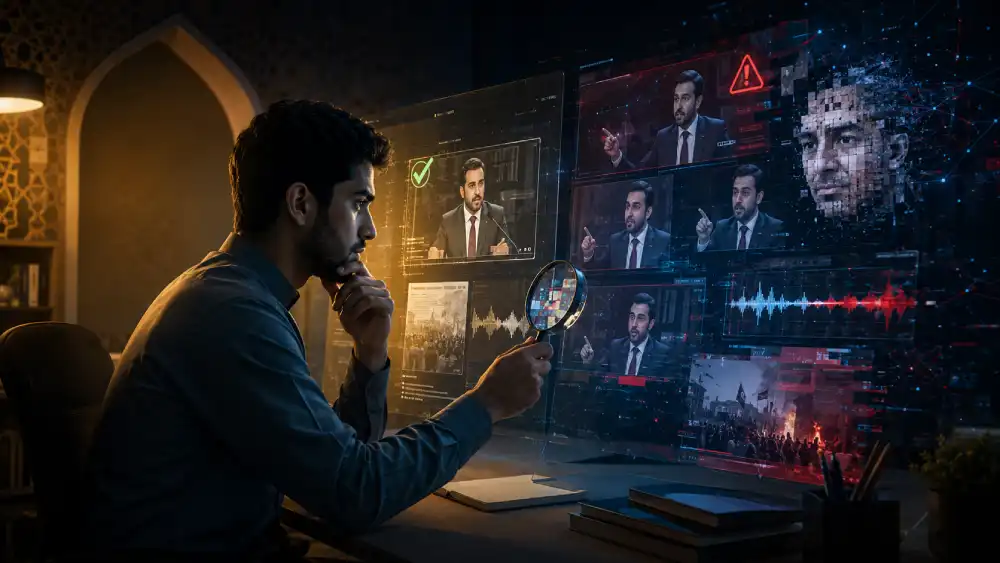
Every powerful technology can be misused. Understanding the risks of artificial intelligence helps Muslims benefit from AI without ignoring its dangers.
Misinformation and Fabricated Content
AI systems can produce answers that sound confident but contain factual errors, invented references, or misleading conclusions. They may also generate realistic images, voices, and videos that make false events appear genuine.
Allah says:
﴿يَا أَيُّهَا الَّذِينَ آمَنُوا إِنْ جَاءَكُمْ فَاسِقٌ بِنَبَإٍ فَتَبَيَّنُوا﴾
[سورة الحجرات: 6]
Verification is therefore essential. Muslims should not share AI-generated claims simply because they are well written or visually convincing. This is especially important when content concerns a person’s reputation, religious teachings, medical guidance, or public events.
Incorrect Religious Answers
One of the greatest concerns in AI and Islam is relying on artificial intelligence for fatwas or complex matters of belief and worship. AI may combine information from reliable and unreliable sources, misunderstand the details of a question, omit scholarly differences, or invent evidence.
Religious knowledge is a trust. Muhammad ibn Sirin رحمه الله said:
“Indeed, this knowledge is religion, so consider from whom you take your religion.”
(Introduction to Sahih Muslim)
AI may help locate general information, but it should not be treated as a scholar. Questions involving halal and haram, personal circumstances, contracts, marriage, inheritance, or other serious matters should be directed to qualified people of knowledge.
Privacy and Data Protection
Users sometimes enter private conversations, business information, student records, family problems, or personal documents into AI platforms without considering how that data may be processed.
Respecting privacy is part of Islamic character. Muslims should avoid uploading confidential information without permission and should understand a platform’s privacy settings before using it. Organizations working with children, patients, employees, or clients have an even greater responsibility to protect entrusted data.
Deception, Cheating, and False Attribution
AI can be used to complete assignments, imitate another person’s writing, create false identities, or present generated work as original human effort. Such conduct may involve lying, cheating, or taking credit for work a person did not perform.
The Prophet Muhammad ﷺ said:
“Whoever deceives us is not one of us.”
(Sahih Muslim)
Ethical AI use requires transparency. Students should follow their school’s rules, employees should respect workplace policies, and creators should not use AI to copy or misrepresent the work of others.
Truthfulness is fundamental to responsible technology use. Read The Importance of Honesty in Islam to learn how honesty protects individuals and communities from injustice and corruption.
Bias and Unfair Decisions
AI systems learn from data that may contain human bias or incomplete information. As a result, automated decisions can unfairly disadvantage individuals or groups.
An Islamic perspective on artificial intelligence requires justice in both design and use. Organizations should not assume that a computer-generated result is automatically neutral. Decisions that affect employment, education, finance, safety, or access to services require human oversight and a meaningful way to correct errors.
Harmful and Immoral Content
AI may be used to create or distribute indecent material, imitate people without consent, expose private faults, or intensify harassment. The speed and scale of automated content can make the harm far greater.
Muslims are responsible for what they create, request, consume, and share. A tool does not remove accountability from the person directing it.
Islamic Ethics of Artificial Intelligence
The Islamic ethics of artificial intelligence can be understood through several guiding values.
Beneficial Purpose
Technology should be used for lawful and worthwhile aims. Before using AI, a Muslim should consider whether the intended outcome brings benefit or facilitates harm.
Truthfulness
Users should verify claims, avoid fabricated evidence, disclose AI assistance when necessary, and never use generated content to deceive others.
Justice
AI should not be used to oppress, discriminate, manipulate, or deny people their rights. Human beings remain responsible for reviewing decisions and correcting unfair outcomes.
Privacy and Trust
Private data, conversations, images, and documents are trusts. They should not be shared with an AI tool carelessly or without the owner’s permission.
Human Responsibility
An AI system does not possess human faith, intention, conscience, or moral accountability. People must remain responsible for the choices made with its assistance. “The AI decided” is not an acceptable excuse for avoidable harm.
Moderation
Excessive dependence on AI may weaken critical thinking, creativity, study habits, and real human relationships. Muslims should use technology as a servant, not allow it to control their time and attention.
These values make responsible AI use for Muslims a matter of worship and character, not merely digital skill.
Can Muslims Use AI to Learn About Islam?
Muslims may use AI as a starting point for general learning, brainstorming questions, organizing notes, or finding topics that require further study. However, every religious answer should be treated as unverified until it has been checked against the Quran, authentic Sunnah, reliable scholarly works, or a qualified teacher.
A helpful distinction is:
- AI can assist with finding and organizing information.
- Qualified scholars and teachers provide religious authority, context, and judgment.
This distinction protects learners from accepting invented hadiths, inaccurate Quranic explanations, or rulings that ignore their actual circumstances.
When AI provides an Islamic claim, ask for the original source, verify the wording, check the authenticity of hadiths, and confirm that the explanation comes from recognized scholarship. If the matter affects an important decision, ask a qualified scholar directly.
Responsible AI Use for Muslim Families
Parents have an important role in teaching children how to use AI wisely. Young people may assume that a fluent answer is always correct or that using AI to complete schoolwork carries no ethical concern.
Families can establish clear habits:
- Never share names, addresses, passwords, private photographs, or family details with an AI tool.
- Verify important information using trusted sources.
- Do not use AI to cheat or avoid learning.
- Ask permission before uploading another person’s work or image.
- Avoid generating harmful, indecent, or mocking content.
- Keep a healthy balance between screen time, worship, study, family, and physical activity.
- Speak to a trusted adult when AI produces disturbing or confusing material.
Parents should model the same behavior they expect from their children. Responsible digital character is strengthened when honesty, privacy, and accountability are practiced throughout the home.
The same principles apply across other online platforms. Our guide on how to use social media responsibly offers practical advice for maintaining Islamic values in digital life.
Practical Questions to Ask Before Using AI
Before relying on an AI-generated result, pause and ask:
- Is my purpose lawful and beneficial?
- Have I shared any private or confidential information?
- Could this answer be incorrect or incomplete?
- Do I need to verify it with an expert or primary source?
- Am I using AI honestly, or am I hiding its role?
- Could the output harm someone’s rights, dignity, or reputation?
- Am I still applying my own judgment and taking responsibility?
- Would I be comfortable answering to Allah for this use?
These questions turn abstract discussions about artificial intelligence Islam and ethics into practical daily conduct.
Conclusion
Artificial intelligence offers valuable opportunities for education, accessibility, productivity, and community service. At the same time, it can spread misinformation, weaken privacy, enable deception, and produce serious errors in sensitive matters.
The Islamic response is neither blind acceptance nor automatic rejection. An Islamic perspective on artificial intelligence evaluates each use according to its intention, method, and consequences. Technology should serve truth, justice, dignity, and beneficial knowledge rather than replace human responsibility.
Muslims may use AI as a helpful tool, but they should verify its outputs, protect private information, remain honest about its use, and consult qualified scholars for religious guidance. In every discussion of AI and Islam, one principle must remain clear: greater technological power brings greater responsibility before Allah.
May Allah grant us beneficial knowledge, wisdom in using new technologies, protection from their harms, and sincerity in everything we create and share. Ameen.
Reflection Question
What is one change you can make today to use artificial intelligence more honestly, safely, and responsibly?